|
Changing Organizational Cultures - Advocating for Social Responsibility
"Corporate Social Responsibility" is a movement motivated in part by business self-interest, but also by a genuine understanding that economic inequality, social injustices, and environmental degradation need to be reversed if we are to thrive as individuals and as a species. So, there is room for every person, and every organization, to contribute to improvement of the "global commons" and our own communities. This is the promise, and the challenge, of the global social responsibility movement.
How can different organizations improve their impacts within their own networks? The voluntary global guidance standard, ISO 26000, explains principles, core subjects, management procedures, how to engage stakeholders,and how to communicate progress. Slide presentation: "Basic Training Materials, ISO 26000" revised and updated January 2022, gives an accessible introduction. Creative Commons license; non-commercial, free to download, use and pass along to others.
The SGN (Stakeholders Global Network) was founded in October 2018.
By November 2024, the SGN has grown to over 100 members from all stakeholder groups (Consumer, Industry, Labour, NGO, Government, Academic/Research/Consultants, and National Standards Bodies). SGN members participate in quarterly meetings, organize online and in-person events, and provide a web platform with resources open to all.
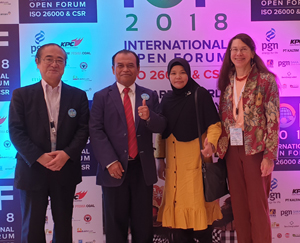 At the founding meeting in Bali, Indonesia:
Ken-ichi Kumagai from Japan, Suharman Noerman and Rocelyn Dador Dalfin from Indonesia,
and Carolyn Schmidt from ECOLOGIA
Presentations from Online Events Hosted by ISO 26000 Stakeholders Global Network
Humanitarian Aid and Disaster Management - The Roles of NGOs
Panelists from Japan, India and Benin discuss their experiences. [October 2023] Organized by the NGO Stakeholders Group of the ISO 26000 Stakeholders Global Network.
Slide presentations
- Vulnerable Groups in ISO 26000 - Carolyn Schmidt, ECOLOGIA
- Kenya - Raphael Obonyo, The Youth Congress, "Impact of COVID-19 on vulnerable groups (youth)"
- Palestine - Nur Al-Aagha, "Situation of Gaza Strip dealing with COVID-19 crisis"
- Japan - Yoshiteru Horie, Japan Association for Aid and Relief (AAR Japan), "Impacts of the pandemic on vulnerable groups: AAR Response to COVID-19, for People with Disabilities on Japan"
- Bahrain - Khawla Al-Muhannadi, "Environmental Impacts of Covid-19"
- Brazil - Pedro Cunha, LACEMOS, "Impacts of the pandemic on vulnerable groups"
- India - Reshma Sambare, Jhep Foundation, "Impacts of the pandemic on vulnerable groups"
Transcript of the event - print format
Healthcare and cure in the Netherlands [April 2022]
ISO 26000 in Healthcare and cure in the Netherlands
Enter this passcode to view the video (75 minutes total): 47b^5kFH
ECOLOGIA's Handbook is designed for small and medium sized businesses, to encourage them to use the global guidance standard, ISO 26000, to improve their Corporate Social Responsibility.
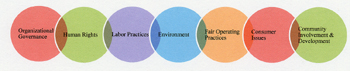
The 33-page Handbook features:
- Explanations of the goals and value of ISO 26000
- Workbook - with worksheets, tables, graphics, questions and examples
- Definitions, principles and action suggestions of the seven core subjects (summary)
ECOLOGIA's Handbook is copyrighted, and licensed under Creative Commons (www.creativecommons.org). You are encouraged to download, view and/or print, and use our Handbook, as long as you credit ECOLOGIA, and do not alter the Handbook or charge a fee for using it.
Promotion of ISO 26000
Bali, Indonesia: Open Forum on ISO 26000 Social Responsibility, October 2014
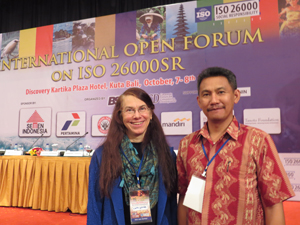
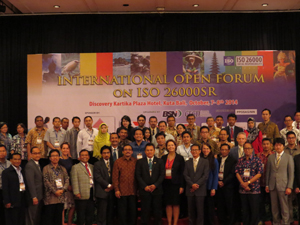
Over 200 representatives from Indonesian mining, energy, and cement companies, local government and civil society organizations gathered in Bali in October 2014. The goal was to exchange information and practical experiences about ways to improve business impacts on their communities. The Indonesian participants were joined by experts involved in ISO 26000, from Japan, the Netherlands, and ECOLOGIA.
Developing ISO 26000: Negotiations 2005-2010
Official "launch" of ISO 26000 in Geneva, Switzerland, November 2010
A multi-year process created guidelines to encourage environmentally and socially sustainable activities by local, national and multi-national organizations worldwide. The document, ISO 26000, is not designed for formal certification, but as voluntary guidelines accessible to all kinds of organizations in every country, across the globe. Participants included representatives from industry, government, labour, consumer, NGO and consulting/academic organizations, from all continents and many different countries. The process operated through consensus-based decision-making and gives numerous opportunities for different participants to raise, clarify and debate their viewpoints. This has been a multi-year and multi-stakeholder process, which uses a consensus-based approach to solve disagreements. The goal is to encourage organizations from all over the world to change their operating practices to improve their environmental and social impacts.
ISO 26000 is a part of the increasing global support for 'corporate social responsibility'. By including all kinds of organizations, not only businesses, this is an example of the creation and deepening of global civil society institutions. And it is very much a "work in progress". For more information, see ISO Working Group on Social Responsibility, on the ISO website.
"Working Group" Plenary Sessions Obtain Global Input to Create the International Standard
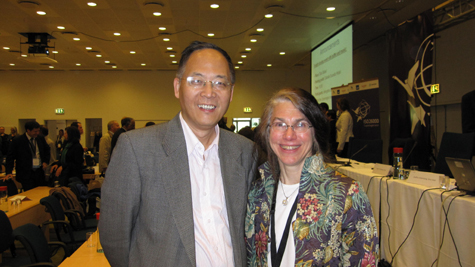
COPENHAGEN
The 8th Plenary of the Working Group on Social Responsibility took place in Copenhagen, May 2010. Over 400 of us triumphed over volcanic ash, economic hardships and other forms of global turmoil to get to Copenhagen for a week of multi-stakeholder and multi-dimensioned debate. We achieved consensus (though not unanimous agreement) on the wording of ISO 26000 - the International Guidance Standard.
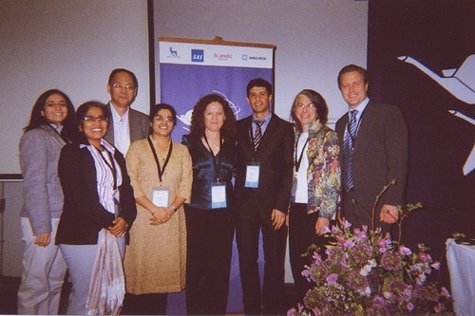
This photo captures the joy that many of us were feeling at the close of the session. Although, as Staffan Soderberg (extreme right), the Vice-Chair of the ISO WGSR, said in his closing comments, "I've experienced the entire range of human emotions during this process!"
Many of the issues discussed had been with us for several years:
- To what extent should ISO 26000 cite existing certification standards and "voluntary initiatives"?
- Should the "precautionary approach" consider the balance between long-term and short-term costs and benefits?
- How should users handle situations where national laws, or traditional customs, differ from "international norms" as expressed in documents agreed on in the United Nations?
- How can the standard be useful to large multi-national corporations, AND small businesses, AND non-profit or public service organizations such as hospitals, AND organizations located on all the continents?
The Final Draft International Standard (wording agreed in Copenhagen) was voted upon by ISO member bodies in September 2011. Most of the participants in the Working Group wanted it to be freely available as our gift to the world, and to encourage the most widespread adoption and experimentation. However, the ISO leadership decided that the standard should be sold through the National Standards Bodies, the same way that other ISO standards are sold.
A Living Document - Monitoring and Revising through the Post-Publication Organization
In order to track the ways that ISO 26000 is actually used around the world, to gather examples and to use our knowledge to improve it at the first revision (around 2013), the Working Group voted to set up a Post Publication Organization (PPO). This will have membership from the ISO WGSR leadership, and from each of the six "stakeholder groups" - Industry, Government, Labour, Consumer, NGO and SSRO. Carolyn Schmidt of ECOLOGIA was elected to the NGO Steering Committee, an alternate NGO delegate to the PPO.
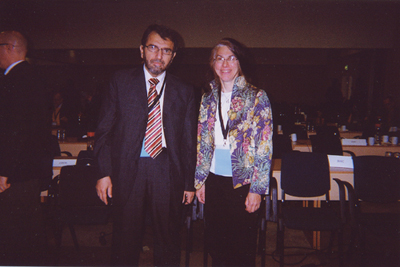
Dr. Sufyan Al-Irhayim, Head of Standards for Saudi Arabia, and Carolyn Schmidt of ECOLOGIA worked together to ensure that radioactive wastes were included in the "prevention of pollution" section. This was one of many instances where delegates representing diverse constituencies found common ground on specific issues, despite differences on others.
QUEBEC
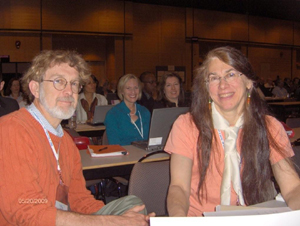
In May 2009, the 7th Plenary in Quebec City, Canada was hosted by the Bureau de normalisation de Quebec (BNQ) which planned carefully to make this event as ecologically friendly and "zero waste" as possible. Randy Kritkausky and Carolyn Schmidt represented ECOLOGIA during the week-long discussions and negotiations. Some of the issues we were involved in which aroused the most participation included -
- Should the "precautionary principle" be included in the environment and consumer sections? (YES) [the precautionary principle is that, when there is risk of serious harm to the environment or human health, organizations shouldn't wait for full scientific proof before taking precautions];
- Should "Fair Operating Practices" include the concept of "fair treatment of the costs and benefits of implementing social responsibility throughout the supply chain"? (YES, with the stipulation that each organization, no matter how small, bears the responsibility for its own actions, and with the suggestion that purchasers can provide support in many ways, including but not limited to financial);
- How should ISO 26000 treat the many other initiatives and tools on social responsibility that have been, or will be, developed and made available? For example, UN Global Compact, GRI (Global Reporting Initiative), ILO (International Labour Organization), etc. (NO CONSENSUS REACHED; This was referred to a small group for continuing discussion.)
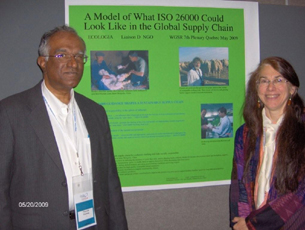 Thomas Thomas, Labour Delegate from Singapore, and Carolyn Schmidt of ECOLOGIA, in front of ECOLOGIA's poster on the supply chain for cashmere, displayed in Quebec.
SANTIAGO
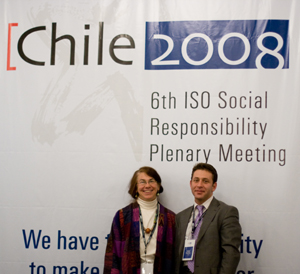
At the 6th Plenary in Santiago Chile (September 2008), Carolyn Schmidt (US citizen) and Sergey Dayman (Russian citizen) represented ECOLOGIA. Key issues debated included questions about whether ISO 26000 would be deemed by the WTO to be a "non-tarrif barrier to trade", the extent to which it could apply to and be useful for governmental bodies, and the applicability of international norms and agreements, such as the Declaration of Human Rights, to people in all countries. The Chilean governmental ministers who addressed the plenary session stressed the significance of ISO 26000 for small and medium size businesses, and encouraged delegates to make working conditions in developing countries a priority.
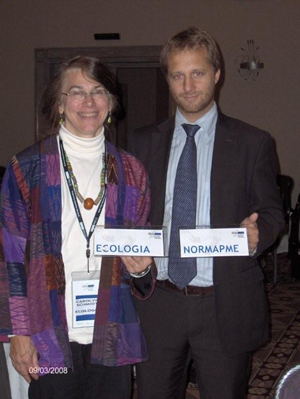
Carolyn Schmidt and Sebastiano Toffaletti from Industry - representing NORMAPME, a European umbrella organization for small businesses which average less than 10 workers - worked to write and advocate for a section specifically explaining how small and medium-sized organizations could use ISO 26000. Since small-scale businesses employ 90% of the workforce worldwide, this is a very important sector to support in the quest to increase social responsibility.
VIENNA
At the 5th Plenary in Vienna, Austria, November 2007, Carolyn Schmidt and Sergey Dayman represented ECOLOGIA. A grant from the Trust for Mutual Understanding supported Sergey's travel costs; for the first time, a Russian Non-Governmental Organization was represented at an ISO SR plenary. See Mr. Dayman's reflections on the current state of CSR in Russia, "Russia in 2008: CSR in a Post-Socialist State".
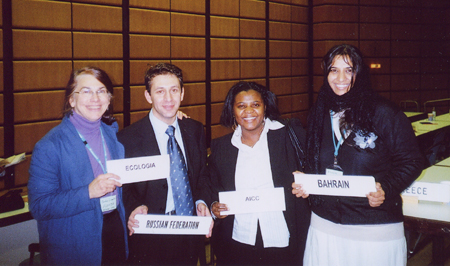 This session was characterized by thoughtful and sometimes contentious discussions between delegates representing different constituencies. We made notable progress on several hotly debated issues, such as how to include supply chain relationships, the role of third-party evaluations, and how to deal with international norms and expectations of behavior when these conflict with national or local laws.
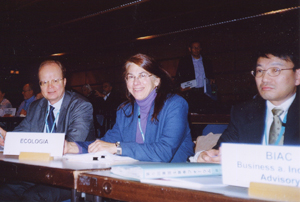
We also decided that organizations using the standard "should" (not "may choose to") report on each of the seven "core subjects":
- organizational governance
- human rights
- labour practices
- fair operating practices
- environment
- consumer issues
- contribution to the community and society.
This should strengthen the usefulness of the standard, since it will encourage users to examine the impact of their decisions in each of those seven issue areas.
ECOLOGIA continues to see the supply chain / value chain relationships as one of the keys to make the ISO 26000 guidance standard meaningful and useful. Much work remains to be done. See ECOLOGIA's Briefing Papers on the issue of supply chain management in the context of Chinese manufacturing:
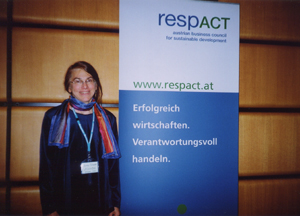
While in Vienna, Carolyn also participated as a panelist at a meeting of the Austrian Business Council for Sustainable Development; the topic was "Corporate Social Responsibility: Voluntary Standards or Regulations?"
SYDNEY
Sydney, Australia hosted the 4th Plenary of the ISO Working Group on Social Responsibility, January-February 2007
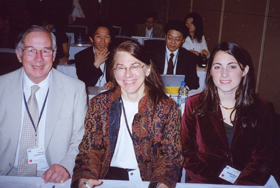 ECOLOGIA's delegates, Carolyn Schmidt and Katharine Cooley, dealt with issues such as:
- how can the guidelines be written clearly and simply, to apply to all types of organizations?;
- how can organizations best identify their "stakeholders" (those whom they affect, with whom they need to communicate);
- and how should the standard direct its users to act with regard to their supply chains (organizations they buy from and sell to)?
LISBON
In Lisbon, Portugal, May 2006, ECOLOGIA participated in the 3rd Plenary of the ISO Working Group on Social Responsibility.
The ambitious goals for this session included major substantive progress on the different elements of the SR standard (definition and scope, core concepts, guidance on specific issues) and major procedural process to ensure effective and diverse participation for the remaining two years of developing the standard. Emerging from a week of discussions and debates, a major achievement of this session was the creation of numerous ad hoc Task Groups, charged with developing language and identifying areas of agreement for specific topics. Work to empower a variety of non-traditional ISO stakeholder groups - such as developing countries, consumer and labor organizations, and NGOs - continues. The difficulties of meaningful participation by Non-Native English speakers have emerged, and should be a topic for consideration before the next plenary.
In addition to Randy Kritkausky and Carolyn Schmidt, ECOLOGIA also supported the attendance of the Lithuanian NGO observer delegate, Giedre Donauskaite.
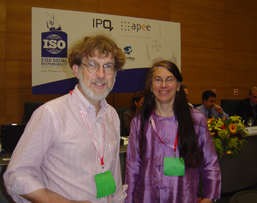
BANGKOK
September 2005 - Bangkok
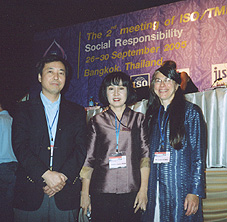
The 2nd Plenary of the working group met in Bangkok, Thailand. We achieved the main goal for this session - agreement on the Design Specification for the new standard. The 350 delegates (from 43 countries and 24 international organizations) worked according to ISO's consensus approach, in which everyone participating needs to support decisions, and differences are talked out and resolved by deliberation and compromise. The goal is to ensure that all participants (different nations and 'stakeholder groups') will support the final product.
SALVADOR, BAHIA
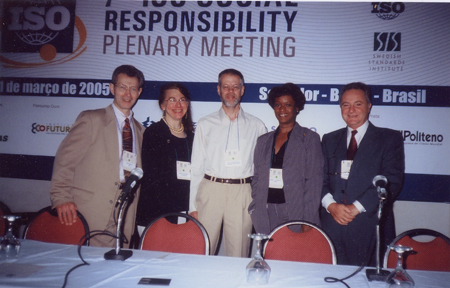
March 2005 - The First Plenary - Salvador, Bahia
From March 7 – 11, 2005, ISO brought together over 300 delegates from around the world, at its First Plenary on Social Responsibility in Salvador, Bahia, Brazil. This was, and still is, a new field for the Geneva-based ISO, known for writing technical standards (dealing with issues such as the compatibility of nuts and bolts) and management process standards such as ISO 9000. Over the last five decades, ISO has developed thousands of voluntary standards created largely by and for industry. The primary purpose of these standards has been to make it easier for companies to trade across international borders and to be able to have guarantees of product component compatibility and quality. As a result ISO has become the pre-eminent global standards making organization.
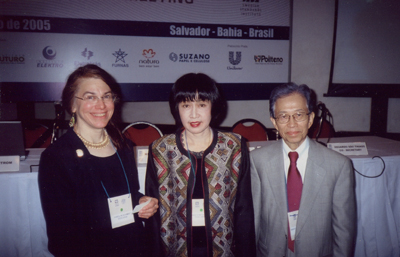
March 2005 Background on ISO SR and Global Governance
ISO (the International Organization for Standardization) is taking important steps toward the development of a global standard on social and environmental sustainability. ISO is referring to this as a standard on “social responsibility”, a somewhat misleadingly narrow term given the fact that the standard is expected to address a broad range of organizational activities including social, labor, and environmental impacts. As ISO develops this new standard, it should transform how concepts like “corporate social responsibility” and “the triple bottom line” are defined, measured and reported on. Of equal importance, ISO has established a ground-breaking new approach to stakeholder involvement in its own standards development that could transform the world of standards making and spill over into the broader sphere of global governance. ISO identified six different categories of "stakeholders"; these categories are all represented among the delegations creating the new standard. Industry, Government, Labour, Consumer, NGO, and SSRO (Service, Support, Research and Others).
Purpose of ISO 26000 - the global "Social Responsibility" standard:
The Goal of the ISO Social Responsibility standard is to encourage organizations around the world to improve their performance on key indicators of sustainable development. By reducing environmental damage caused by their operations, and improving the living conditions and health of their workers, organizations have the ability to improve the quality of life for the communities in which they operate.
Challenges
As the process started, (March 2005), there were six major challenges facing the creation of the ISO Social Responsibility standard:
- How can it apply to a variety of organizations (industry, government, non-profits, labor unions, etc.) without becoming so weak and vague that it lowers rather than raises expectations about performance?
- How can the "multi-stakeholder approach" be fairly implemented, given the dominance of the English language, and the western style of parliamentary debate, during working group sessions?
- How can it apply both to developing and developed countries without being unrealistically demanding on the former, or providing no incentives for the latter ?
- How can it address the needs of a range of organizations, including small and medium-sized enterprises, when ISO standards traditionally have required specialization and have been used mainly by large corporations with resources to implement them and to pay for ISO certification?
- How exactly will organizations that use the ISO SR standard be required to communicate with their stakeholders (the people and groups impacted by the organization’s actions)? Indeed, how will ‘stakeholders’ be identified and defined? These decisions are very significant, because if ‘stakeholders’ are defined too narrowly, much of the potential of the ISO SR standard for community dialogue and public accountability will be lost.
- How can it directly incorporate supply chain responsibilities and purchaser/consumer information, so that it will be truly useful as the chain becomes more global and complex?
Procedures
ISO is working to make the development of its ISO SR standard as representative and inclusive as possible. The process will take at least three years. Participation by representatives from a wide variety of stakeholder groups is crucial for them to 'buy into' the standard and to believe in its usefulness. Six "sectors" were identified; each country participating is encouraged to involve a representative from each one: industry, government, labour, consumers, NGOs, and "others" (service, support, research and others).
Decisions Made in Advance - The Framework Provided by ISO
- The standard will be for "guidance" only - ISO will not require third party certification.
- The standard will be written in accessible language, making it "user-friendly" to understand and to implement.
- The standards development process will involve representatives from developing countries intensively. There is a "twinning" requirement: each committee, as well as the SR standard-development process overall, will be co-chaired by a pair of representatives, one from a developed country, and one from a developing one. For example, the Co-Chairs of the First Plenary were from Sweden and Brazil.
- Liaison Organizations (such as ECOLOGIA) will be given a more prominent role in the writing of the SR standard than in previous ISO standards. Liaison members are internationally active organizations with expertise in specific areas relevant to the ISO standards work. Historically, ISO membership has focused around National Standards Bodies in each participating country; Liaison representatives had observer status at ISO meetings. But for the ISO SR standard, Liaison expert delegates have been approved for functions such as voting and co-chairing committees.
Evaluation at the start
The new ISO SR standard provides an unprecedented opportunity for global discussion and widespread involvement to implement the goals of “sustainable development” at many levels of organizational activity throughout the world. We at ECOLOGIA see this as an opportunity to increase the influence and capacity of civil society organizations as we work together toward truly sustainable and equitable global development.
ECOLOGIA Background and Briefing Papers: Examining the Issues, Proposing Solutions
ECOLOGIA Briefing Papers on Participation in Standards Development - Prepared for ISO SR Working Group Plenary Sessions in Lisbon, May 2006
- Opportunities and Options for ISO at the Crossroads: ISO 26000 Stakeholder Solutions April 2006
- Partnerships for the ISO Global Social Responsibility Standard:
Funding Strategies to Ensure Diverse Stakeholder Participation May 2006
- Putting Economics Back into the Social Responsibility Equation: The Principle of "Fiduciarity" May 2006
NGO Participation in the ISO Working Group on Social Responsibility
Non-Governmental Organizations (NGOs) represent a range of public interest advocacy and policy groups. They comprise an important "stakeholder" group, as they provide expertise and 'checks and balances' to ensure consideration of a wide spectrum of concerns, when global decisions are made.
<

|
