One World-One Dream
ECOLOGIA’s China-Vermont exchange,
August 2008
What do China, the world’s most populous country, and the state of Vermont, which would be a small municipality if it were in China, have in common? You could have felt the answer if you had been sitting in our kitchen on the evening of August 8, 2008. We were fixing dinner with our three Chinese guests while the dazzling Beijing Olympics opening ceremony played on television. Three days earlier one of our guests, Ren Xuping, had carried the Olympic torch through the streets of Chengdu, in Sichuan Province. Ren had been chosen for this honor because he had risen from poverty, made a fortune raising rabbits, and then, along with Zhang Shuping, his wife, has helped over 300,000 rural Chinese to rise out of poverty. Ren and Zhang are known as the “Rabbit King and Queen” in China. They, along with ECOLOGIA’s China Program Director, Du Heng, came to Vermont bearing the sustainable development and social responsibility torch. Why Vermont? Why now?
For the past two years, ECOLOGIA has been working with the Rabbit King and Queen on sustainable development and poverty alleviation projects in their home region of Sichuan Province. On May 12, 2008, Sichuan Province experienced a devastating earthquake. Tens of thousands were killed, millions became homeless, and businesses were razed to the ground. Our work sites were rural villages near the earthquake epicenter. Within days of the quake we added earthquake relief and sustainable re-development micro-loans for villages to our project portfolio. Within two weeks ECOLOGIA staff, Ren, Zhang, and Sichuan entrepreneur association leaders were making plans for the sustainable re-development of Sichuan’s business enterprises. Since their buildings and business plans had been reduced to rubble, our Chinese colleagues were asking ECOLOGIA strategic questions:
-
How can we rebuild our factories in the most energy-efficient and environmentally friendly way?
- How can we reassemble our business operations in a more environmentally friendly and sustainable manner?
- How can we re-launch Sichuan businesses with a new regional “green” brand name?
- How can we turn this new Sichuan green business model into an added value business opportunity?
- How can we network Sichuan businesses so that they can collectively pursue these goals?
- If we are going to re-build and repair earthquake damaged villages, how can we strengthen communities in the process?
With grants from the Jan & David Blittersdorf Foundation and the Ben & Jerry’s Foundation, ECOLOGIA was able to bring our program director Du Heng and Sichuan partners the Rabbit King and Queen to Vermont for a study tour and opportunity to explore the above questions. Here is what we discovered together and about one another.
We continually discovered that the Olympic theme of “One World - One Dream” is not just an event slogan. Many individuals and business leaders the world over are profoundly committed to real sustainable development and healthier communities. No country has a monopoly on this vision nor does it have all of the answers about implementing the vision; we can learn from and be inspired by one another. While Ren and Zhang were exploring opportunities to apply ideas from Vermont, they told Vermonters the story of the Sichuan Xuping Rabbit Industrial Corporation and their social mission arm, the Rabbit King Poverty Alleviation Research Center. It became clear that if they were a Vermont business, they would be one of the state’s strong examples of social and environmental responsibility.
 Zhang Shuping and Ren Xuping at Ben & Jerry’s Ice Cream Factory. Zhang and Ren were inspired by the notion that a factory tour can be fun, and can also be a lesson in sustainability and social responsibility
The link between sustainability in China and Vermont was made at our first morning’s breakfast with Matt Mole, founder of the Vermont Organic Fiber Company. Matt discussed his partnership with ECOLOGIA, promoting a fair trade supply chain for cashmere and camel fiber produced in China’s arid Inner Mongolia. The project, funded by Ford Foundation China, is designed to provide herders with a fair price for their fiber, enough not only to support family and community, but also to allow for the restoration of advancing deserts. The key to realizing this outcome lies in a Vermont company that educates consumers and markets fibers in a socially and environmentally responsible manner. Take away applications: if we want to promote local sustainable development in China or on rural Vermont farms, we need to support it with fair global supply chains. ECOLOGIA and Ren and Zhang are developing marketing mechanisms for Sichuan Xuping Rabbit Company products that will give them more added value and financial resources for their poverty alleviation and sustainable development work.
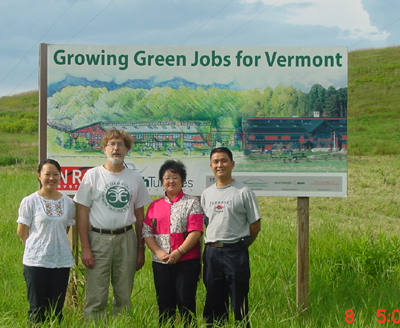
Du Heng (ECOLOGIA’s China Programs Director), Randy Kritkausky (ECOLOGIA’s President) Zhang Shuping (the Rabbit Queen) and Ren Xuping (the Rabbit King) stand in front of a sign documenting NRG’s impact on the local economy.
First site visit, to NRG Systems and Earth Turbines in Hinesburg We wanted Ren and Zhang to see “the building” we had been telling them about since we first met. NRG Systems and Earth Turbines are housed in beautiful manufacturing buildings, which have earned gold LEED certification from the U.S. Green Building Council and are among the most energy efficient factories in the world. ECOLOGIA believes that this model of a 21st century factory needs to be replicated in China, by a medium sized company like the Sichuan Xuping Rabbit Company. Such a building could cost about eight percent more than a conventional building, but pay back on the added investment happens quickly, and then continues for decades by providing extremely low energy costs and increased worker satisfaction and retention. Ren and Zhang met with and discussed their life-long commitment to social responsibility with NRG’s co-founders David and Jan Blittersdorf. Both couples found validation in becoming part of an emerging global network and the fact that “the little guys” with vision can often lead the way to sustainability. Take away applications: In the next years, if all goes according to plan, an NRG type building constructed by the Rabbit King and Queen will appear at the very center of the Sichuan earthquake zone in a city that is currently flattened. The building, and the socially and environmentally responsible business practices within, can become a beacon for earthquake reconstruction and for a more sustainable China.
Meeting with Vermont Businesses for Social Responsibility (VBSR) – Ren and Zhang were very interested in meeting with VBSR staff and members, as they are working to build a similar network of socially responsible entrepreneurs in Sichuan Province. That network’s inaugural meeting, planned for May 14, had been postponed because of the earthquake. The Chinese entrepreneurs who had planned to attend have already turned earthquake reconstruction into an opportunity to move forward with social and environmental responsibility initiatives in Sichuan Province. As the earthquake stimulated an outpouring of corporate philanthropy in China, Sichuan entrepreneurs determined to make this business model shift toward community engagement permanent. They have begun discussions on how to embed corporate social and environmental responsibility in the daily operations of businesses, not just in emergency support.
So, when we met at the VBSR offices in Burlington, Ren and Zhang were extremely interested in discussing how such a network of entrepreneurs can promote a rising tide of corporate social responsibility. Will Patten, VBSR’s Executive Director, discussed the importance of reaching out to those businesses and government officials who have not yet discovered the social responsibility approach, and Andrea Cohen explained the ways that VBSR works on public policy issues at the state level. Ralph Meima, director of the Marlboro Graduate MBA in Managing for Sustainability program, discussed how “Made in Vermont” branding adds value to products made in the state. We discussed how Vermont’s rural agricultural “clean and green” image transfers to other regional manufactured products, and how the experience may be applicable to Sichuan Province whose regional, national, and global reputation is based on Sichuan cuisine. Rob Michalak of Ben & Jerry’s discussed international purchasing and marketing with a social mission. Gregor Barnum and Martin Wolf of Seventh Generation demonstrated their successful combination of mission-driven long-term planning and constant attention to innovation and detail. Take away applications: Ren and Zhang have already made a formal report on their Vermont trip to the Sichuan entrepreneurs’ network. They are crafting recommendations for provincial authorities, on promoting corporate social responsibility. In the spring of 2009, a larger delegation of Sichuanese entrepreneurs, local officials and business journalists hopes to visit Vermont for a more extended study tour and to plan for more cooperation with VBSR and with Vermont’s businesses.
Visit to Otter Creek Brewing and Wolaver’s Organic Ales, Middlebury - When the owner of a business- Morgan Wolaver - takes you on a tour of his factory, and his employees show the manufacturing process in detail to visitors on a daily basis, an important message about transparency gets through. China is suffering from a devastating negative brand name associated with its manufactured food products. Once again a Vermont experience showed the way to a solution. Take away applications: Ren and Zhang are contemplating how their own food processing plants can incorporate more openness and transparency, including tours and retail stores, as part of a branding and consumer education strategy.
Visit to Ben & Jerry’s Ice Cream Factory, Waterbury - For those who do not live in Vermont, the fact that an ice cream factory is the state’s number one tourism destination may come as a bit of a shock. Ren and Zhang were intrigued with the fact that two inexperienced entrepreneurs, Ben and Jerry, could turn a business with a strong social mission into an internationally famous brand name, and that visitors would flock to a factory. Take away applications: Ren and Zhang were inspired to begin thinking about making their new factory an enjoyable place to visit and celebrate “doing good”. Their definition of education about corporate social responsibility has expanded to embrace consumer education.
 Zhang Shuping visits a Ben & Jerry’s Ice Cream store in Burlington where branding is all about social mission and responsibility.
Reaching out with the “One World-One Dream” message - Ren and Zhang brought an important message to Vermont: a significant portion of China’s entrepreneurial community is currently committed to social and environmental responsibility. These entrepreneurs need international recognition and validation. They also need support by the global supply and value chains, and by socially responsible global consumers. In order to get this story out and in order to assist these entrepreneurs, Ren, Zhang and ECOLOGIA staff met with Professor Tamara Steger from the Central European University (which is located in Budapest, Hungary.) Professor Steger works with graduate students in the Erasmus Mundus Masters in Environmental Sciences, Policy, and Management (MESPOM) program, a consortium of four European universities. Take away applications: Together we will develop case studies of China’s socially and environmentally responsible entrepreneurs, develop ongoing monitoring of these businesses, and engage students and faculty in assisting these businesses in their development.
Where community and business are one - One of the development challenges facing China is the problem of how “western” affluence is portrayed and glorified, and the implied message that every American has happily subscribed to it. We wanted our Chinese colleagues to see the extraordinary diversity of cultures and lifestyles that exist in the United States, including voluntary communities organized around living simply and in harmony with the land. We also wanted our colleagues to see a community-embedded business as we thought this might be an alternative or complementary model for the Chinese rural villages where we are currently supporting individual entrepreneurial efforts. Our final visit was an overnight to the Fox Hill and Bellvale Communities in the Hudson River valley region of New York State. These are Church Communities in the Anabaptist (German Reformation Christian) tradition.
These intentional or voluntary communities have historical roots in early Christianity and its concepts of shared wealth wedded to communal living. In addition to active farming and food production, they have a network of factories which, since 1954, have produced Community Playthings - fine handcrafted wooden toys, furniture and outdoor play equipment for children and schools. (http://www.communityplaythings.com ). They have an international and multi-racial membership; at Fox Hill, our Chinese visitors met an American who had spent her childhood in China, and still speaks Chinese.
They are very engaged with the outside world. ECOLOGIA first encountered these communities in the early stages of our work in China; they found us over the internet in 1997, and through their own initiative provided birdwatching program information and children’s drawings directly to some of our first Chinese grantees, with the Bills and Feathers project. In 2008, their philanthropy (from communities in the United States and United Kingdom) has been responsible for much of the financial support for ECOLOGIA’s quick response and earthquake reconstruction projects in Sichuan.
Our Chinese colleagues were struck with the level of happiness that they noted in these voluntary communities, whose members technically live below the US poverty line. Finding happiness in community resonated with our own joint poverty alleviation projects in Sichuan where we had been struggling to develop indicators for our micro-loan programs. When we asked Chinese villagers what they wished for, what would be “enough”, they answered, “having our families back together in the community rather than working in distant city jobs.” Ren, Zhang and our ECOLOGIA staff found ourselves asking if we had not found part of the solution in these voluntary communities, where a productive business embedded in a shared community of values produces contentment and provides a safety net for all of its members.
We were all impressed by the organization of “factory” work in these communities. Complex manufacturing tasks are broken down into discrete and manageable steps that can be performed by almost any adult, without intensive training and expensive equipment. As a result, people of various skill and energy levels can all be gainfully employed in a work environment that allows them to work at their own pace. The “assembly line” is flexible and scaled to human needs and quality assurance. In fact, we were surprised and impressed to learn that this unconventional business environment had mastered ISO 9000 quality management several years ago, and then moved on beyond it. They have also adapted their highly flexible manufacturing process to a “just-in-time”system, more effectively than many more mechanized operations. They demonstrate that local and community scaled can also be globally competitive.
In conclusion, these voluntary communities challenge the widespread belief that market forces thrive best in a highly competitive social environment. They raise questions about the paths to sustainability and meaningful lives that mainstream and Main Street 21st century American communities are struggling with. Take away applications: All of us left wondering how to adapt this community business model to our rural Chinese poverty alleviation work. We were inspired to imagine how parts of Chinese rural villages where we work might form their own voluntary work communities based on shared values of sustainability and family. Perhaps “post-modern” development can learn something from “traditional” community life.
The beauty of international exchanges is mutual discovery: seeing ourselves again and newly through the eyes of others.
The most common ground of all, children – This exchange will be etched in our memories as one of unusual openness on the part of its participants. Even as we collectively discussed the most challenging issues, such as sustainable development, breaking the cycle of poverty, and earthquake relief, we found time to share our sense of discovery and wonder. There was no pretense of “I already know this”. No one let imagined dignity get in the way of responding to new and sometimes humble ideas. In the end we simply explored and rediscovered our intertwined worlds. As we departed at the airport, quite appropriately it was the memory of encountering children that was in the forefront of our visitors’ minds. It is after all our children who will inherit the earth we so desperately focused on during this exchange.
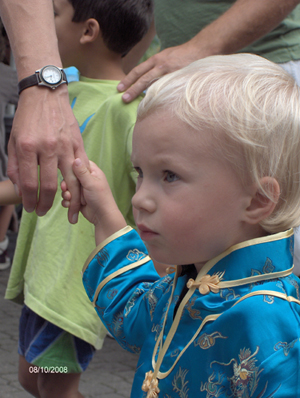 Bjorn Coburn, grandson of Randy and Carolyn, holds the hand of his new friend, Ren Xuping.
Randy Kritkausky and Carolyn Schmidt
ECOLOGIA
Middlebury Vermont USA
August 27, 2008
|